Pioneering LCA projects related to nutrition
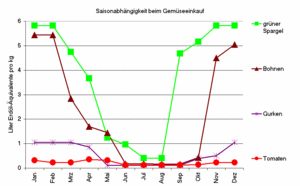
Who hasn’t been standing once in front of the supermarket shelf and asked oneself if the organic carrots from Italy or the cauliflower from the own country is the most ecological choice for the next meal, and then, finally, has decided to buy the delicious asparagus from the USA?
Food production and consumption is a major driver for Switzerland’s environmental impacts
Food production and consumption cause about 25%-30% of environmental impacts in Switzerland. The extent of environmental impacts of food consumption depends on various factors. It is not easy for consumers or even for experts to account for these impacts. ESU-services has conducted several projects aiming to facilitate such judgements. For the analysis of food and environmental impacts as a scientific basis for Swiss dietary recommendations, results from several projects have been summarized in one report.
Presenting key results on environmental impacts of food production and consumption in a webinar
Project examples
EU research for sustainable milk processing
Industrial food production serves to satisfy basic human needs. The dairy industry accounts with 13% turnover for the total food and drink industry in Europe. The aim of the project SUSMILK was to initialize a change within the process chain for market milk and milk products to minimize energy and water consumption and establish the use of renewable energy resources. For the SUSMILK project, 21 partners from all over Europe joined in a consortium co-funded by the European Commission within the Seventh Framework Programme (FP7). Milk processing is characterized by a large variety of heating and cooling processes.
Environmentally friendly and healthy diets
Dietary recommendations guide consumer and teachers on food choices. Nutrition has an impact on human health and the natural environment. Its share of the environmental impact of Swiss final consumption is 20-25%. This depends on the impact assessment method. This environmental damage affects human health. For example, periods of heat in summer lead to deaths due to the climate crisis. If nutritional recommendations only focus on one of the two aspects, both, human health and the environment suffer. ESU-services prepared a report that merges both aspects of nutrition, to ensure sustainability in a healthy and environmentally friendly way. With this …
Ecoprofile of Food styles
This study compares the environmental impact of food consumption scenarios, per person and year. Different food consumption scenarios (average, vegan, vegetarian, protein, etc.) are analysed in a life cycle assessment. The analysis includes the full life cycle of the food products until they are purchased in the supermarket. The study was commissioned by the WWF Switzerland to provide guidance to consumers. The starting point is the amount of food produced for the Swiss market in 2012. The estimation is based on studies for dietary recommendations and pre-defined values by the commissioner.
LCA of vegetarian protein sources
So far, many LCA studies investigated the importance of meat in diets. But, LCA studies or data for alternatives were so far not available in Switzerland. This study investigates the environmental impacts of meals and food products with proteins from plants or fungi (sunflower seeds, almonds, mushrooms, dried soybeans, dried chickpeas, dried lentils, canned chickpeas, soy milk, pre-fried falafel, tofu, textured soy protein and mycoprotein). Several new life cycle inventory data are collected, documented and published. They cover all life cycle stages: agricultural production, processing, distribution, transportation to home, cooling and preparation of the product.
Which Easter bunny is environmentally friendly?
Easter is coming soon, and an increasing selection of Easter sweets can be found in many households. But which chocolate is the most environmentally friendly? The CO2 footprint and the European footprint were calculated for an LCA case study of 100 g Easter bunnies made of dark, white, or milk chocolate. The Easter bunnies made from dark chocolate perform best in this case. Basically, the different types of chocolate differ in their composition. While the proportion of cocoa butter in dark chocolate is very low, the proportion of other cocoa parts (e.g., cocoa powder) is very high.
LCA of organic agriculture and food products
Within this project ESU-services investigates organic and conventional production of milk, dairy products, beef and bread products. The LCA case studies will be used to test the newly developed impact assessment methods on biodiversity and soil quality.
Indicators for monitoring environmental impacts of food consumption
The environmental impacts of food consumption patterns vary from country to country and depend on many different influence factors. ESU-services has prepared an overview of different methods for the OECD Environment Directorate, Project on Sustainable Consumption, that can be used to evaluate these impacts. Here we identified possible indicators for monitoring the impacts of food consumption patterns.
Integrating food waste in LCA of nutrition
A considerable amount of food waste is caused in households due to bad storage, poor planning and consumer’s preference for fresh food. The industrial processes used to prepare ready-meals on the other hand are, for the most part, highly optimized and food waste due to bad handling is minimal. This leads to the question whether overall food losses for a ready-made meal are lower than that of a meal freshly prepared at home. Case study for lasagna Bolognese This question was explored in an LCA study comparing ready-made and home-made lasagne Bolognese.
Environmental impacts of cooking recipes
The SGE (Schweizerische Gesellschaft für Ernährung) has published in their nutrition journal Tabula several recipes for meals which also include information on health aspects and environmental impacts. The recipes themselves are developed by Betty Bossi or Gorilla. ESU-services analysing the environmental impacts per portion. Published recipes (german and french available).
Eco-friendly meals in canteens and restaurants
ESU-services investigated several types of meals provided at home, in restaurants or canteens from an environmental point of view. The life cycle assessment of meals helps also to better understand the reduction potentials for environmental impacts due to organic products or vegetarian diet better than the comparison of single food items. The environmental impacts of avocados The aim of the “Avocado Life Cycle Assessment” is to provide a more differentiated picture of the environmental impact and water consumption in the production and consumption of avocados.
Comparative LCA of tap water and mineral water
Drinking water is a basic necessity. We should drink at least two litres a day. But how can we satisfy this basic need in a manner that is as environmentally friendly as possible? What contribution can tap water make in this context? This was the topic of an in-depth study commissioned by the Swiss Gas and Water Association (SVGW). This study traces the entire life cycle from water catchment/extraction to serving it up in a glass in a life cycle assessment (LCA). Tap water is compared with mineral water and other beverages.
LCA of alcoholic and non-alcoholic beverages
Vegan drinks and whole milk Paula Wenzel investigated “The environmental impact of vegan drinks compared to whole milk” during an internship at ESU-services Ltd. She compared drinks made from oat, soy, rice and almonds with cow milk in 2017. Enology and ecology “Enology and ecology” is the theme of a presentation by Niels Jungbluth for the “Wädenswiler Weintage 2013” at the university of applied sciences in Wädenswil (ZHAW). Wine consumption has a share of about 7% of the environmental impacts caused due to nutrition. The environmental impacts of wine from different origin and grape varieties have been investigated in an LCA.
LCA case study on environmentally friendly meals in canteens
Ascertained measures for an environmental friendly nutrition have been developed by ESU for the SV Group AG who manages about 300 canteens. In a first step, the total environmental impacts of their whole purchases of food products were calculated. This assessment shows that meat products, air-transported products and vegetables grown in heated greenhouses cause an important part of the total environmental burden. Based on this detailed analysis and recommendations, the SV started the initiative „ONE TWO WE” together with the WWF Switzerland, which aims for clear goals for single canteens such as less meat consumption and alternatives to air transported foods.
Data collection in food supply chains
ESU-services is a member of the SENSE consortium involving 23 partners from 13 countries. SENSE is a European research project supported by the 7th Framework Programme of the European Commission. It was launched in February 2012 and will last for three years. The aim of the SENSE project is to deliver a harmonised system for the environmental impact assessment of food&drink products (see video). After the evaluation and the selection of the environmental impact assessment methodologies in Work Package 1, ESU-services conducted two LCAs on Romanian beef production and Romanian dairy products in collaboration with the Romanian partners.
PROFUTURE: optimization of protein-rich micro algae
With the global population expected to grow further, there is a need to find alternative protein sources that can meet future demands for food and protein sustainably. Microalgae have emerged as one of the most promising candidates to address this challenge. However, for the microalgae industry to become more sustainable and competitive, it is crucial to implement innovative technologies and cost-effective production processes. ProFuture (Microalgae Protein-Rich Ingredients for the Food And Feed of the Future) was a research project funded by the European Union’s Horizon 2020 program, which aimed to scale up microalgae production.
Further information
- All our Publications related to environmental impacts of foods
- Analysis of food and environmental impacts as a scientific basis for Swiss dietary recommendations
- LCA database for food production and consumption. Description with detailed information about contents and prices of data sets for sale
- Season calendar for environmental impacts of fruits and vegetables
- Ph. d. thesis of Niels Jungbluth
- Articles and broadcasts in media



