The Way of Living as a Key Driver of Environmental Impacts
Our lifestyle has a major influence on the environment. Life Cycle Assessment (LCA) helps to measure these impacts and supports more sustainable consumption choices.
To raise awareness among consumers, we need a full view of all consumption areas. This helps identify the most important lifestyle factors and shows where individual action can reduce environmental impacts. It also helps people contribute to sustainability goals alongside business and politics.
Research and Experience at ESU-services
Niels Jungbluth, CEO of ESU-services, wrote his dissertation on the project “Energy, Greenhouse Gases and Lifestyles” in 1996-2000. Since then, ESU-services has carried out many studies on lifestyles and environmental impacts.
We have provided data for several footprint calculators, including:
Ideas for climate-friendly lifestyles were also published in an article for FOEN magazine. Similar topics are addressed in the project “Wir leben 2000 Watt” (We are living 2000 Watt) for the City of Zurich.
In this project, a new method was developed to estimate how changes in consumer behavior can reduce environmental impacts in Switzerland. The method helps set priorities for political decisions and focuses on three key areas:
Sustainable consumption patterns were also a topic of the Swiss LCA discussion forum No. 49 (2012), organized by ESU-services.
Potential to Reduce Environmental Impacts
Households and individuals play a major role in reaching Green Economy and Sustainable Development goals. A study evaluated current environmental impacts in Switzerland:
- Energy use: 8250 Watt
- Greenhouse gas emissions: 12.8 tonnes per person
- Environmental impact points: 20 million eco-points per person
More than half of these impacts come from three areas:
- Mobility
- Housing and energy use
- Nutrition
Reduction potential is especially high in the food sector. Key measures include:
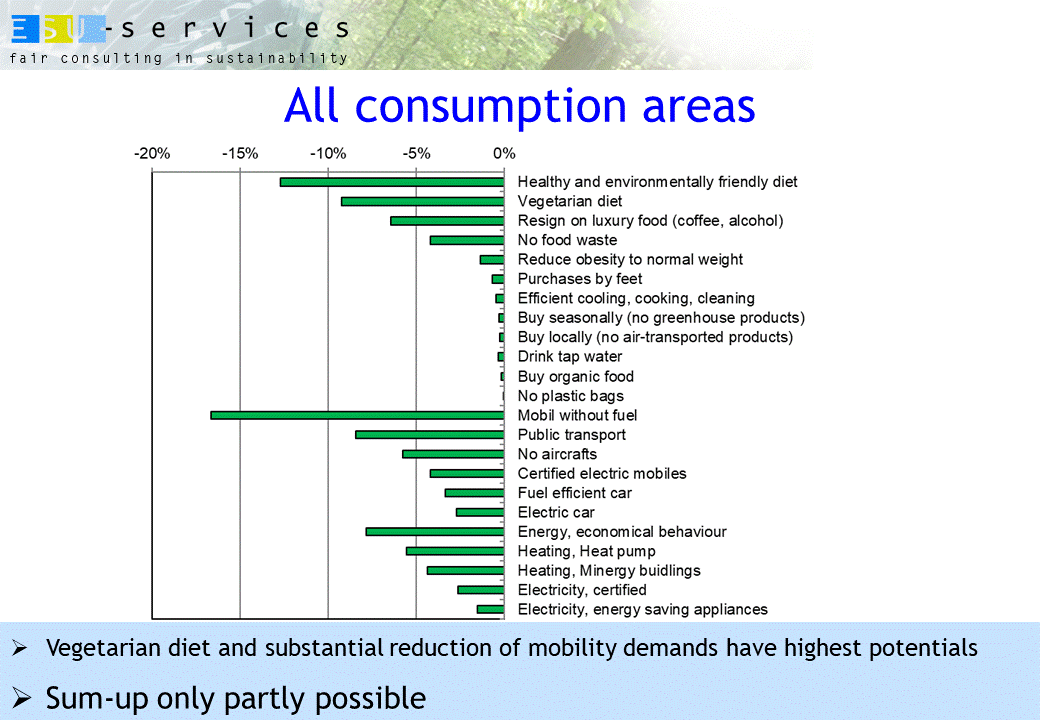
- Eating less meat
- Choosing organic products
- Avoiding food transported by air
- Reducing luxury foods
- Minimizing food waste
Energy‑conscious behavior at home and in transport also reduces greenhouse gas emissions. Using renewable energy and eco-friendly transport is especially effective.
The analytical tools developed in this research can be used to monitor consumption patterns and support campaigns for changing behavior.
Regional Adaptation: Results for the City of Zurich
In a follow-up study, the Swiss reduction potentials were adapted for the specific situation in the City of Zurich.
The study compared environmental impacts of consumption with cumulative energy demand and greenhouse gas emissions according to the 2000-Watt-society methodology. Key findings include:
- Residents of Zurich drive fewer car kilometres.
- They use more environmentally friendly electricity and heating.
- Their environmental impacts are slightly lower than the Swiss average.
However, total impacts from consumption are higher than previously estimated with the 2000-Watt method.
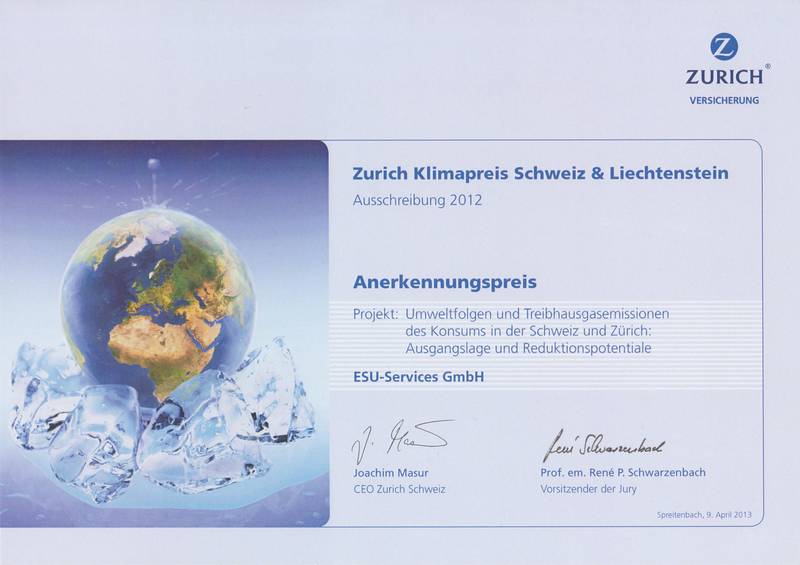
This research forms the basis for planning future measures to reduce household environmental impacts in Zurich. The studies were recognized at the Zurich Climate Prize 2013.
Publications investigating environmental impacts of Swiss consumption patterns
- Christoph Meili, Niels Jungbluth (2018) How WWF Switzerland and WWF Germany improved their consumer awareness campaigns by using LCA-Thinking and an improved environmental footprint calculator. Forum for Sustainability through Life Cycle Innovation e.V., Life Cycle Innovation Conference 2018 (LCIC), Berlin, 30.08.2018
- Kissling-Näf I., Bernath K., Seyler C., Fussen D., Jungbluth N. and Stucki M. (2013) RessourcenEFFizienz Schweiz REFF: Grundlagenbericht zur Ressourceneffizienz und Rohstoffnutzung. Ernst Basler+ Partner AG und ESU-services GmbH im Auftrag Bundesamt für Umwelt (BAFU), Abteilung Abfall und Rohstoffe, Bern.
- Jungbluth N., Flury K. and Doublet G. (2013) Environmental impacts of food consumption and its reduction potentials. Short paper. In proceedings from: 6th International Conference on Life Cycle Management, Gothenburg
- Niels Jungbluth, René Itten, Salome Schori (2012) Environmental impacts of food consumption and its reduction potentials. 8th international conference on Life Cycle Assessment in the Agri-Food Sector, “LCA Food 2012”, Saint-Malo, France, 1-4 October 2012 (Conference Paper)
- Niels Jungbluth, Rene Itten, Matthias Stucki: Environmental impacts of consumption patterns in Switzerland and reduction potentials. 49th LCA Discussion Forum “Sustainable Consumption Patterns” 18. September 2012, ETH Zurich
- René Itten, Niels Jungbluth: A questionnaire for calculating ecological footprint. 49th LCA Discussion Forum “Sustainable Consumption Patterns” 18. September 2012, ETH Zurich
- Jungbluth N., Itten R. and Stucki M. (2012) Umweltbelastungen des privaten Konsums und Reduktionspotenziale. ESU-services Ltd. im Auftrag des BAFU, Uster, CH
- Jungbluth N. and Itten R. (2012) Umweltbelastungen des Konsums in der Schweiz und in der Stadt Zürich: Grundlagendaten und Reduktionspotenziale. ESU-services GmbH im Auftrag der Energieforschung Stadt Zürich.
- Jungbluth N., Nathani C., Stucki M., Leuenberger M. 2011: Environmental Impacts of Swiss Consumption and Production. A combination of input-output analysis with life cycle assessment. Federal Office for the Environment, Bern. Environmental studies no. 1111: 171 pp.
- Jungbluth N., Frischknecht R. and Faist Emmenegger M. (2001) Database Footprint Calculator Switzerland. ESU-services im Auftrag des WWF Schweiz, Uster



